by Jennifer Lang
A few stray hairs rile Mother. Brother isn’t subjected to such scrutiny; Comments like Your long hair looks stringy or must you go out looking like that?
Don’t cry over spilled milk! she says after her beautician hacks my mop to a bob, causing me to sob red-hot tears in the Montclair parking lot before sixth grade begins. Excruciating to forgive, impossible to forget her mothering.
Fun facts: 1) hair’s the second fastest growing tissue in the body after bone marrow; 2) one hair’s stronger than a copper wire with the same diameter; 3) each strand has a lifespan of about five years and; 4) new hair grows as soon as it’s wrenched from its follicle.
Grand Lake Theatre near our house in northern California features the latest rage: Hair, in spring of ’79, freshman year of my cliquish high school, where everybody knows everybody, making me want to run away, start anew, live elsewhere. I memorize every lyric but am not literate enough to comb through the deeper layers of meaning, to distinguish situation from story.
Junior year, Mother eyes me, asking Why are you constantly scratching? and drags me to the pediatrician. Keen and conscientious, her mothering. Listen, Doctor says after examining my scalp, picking’s a nervous habit, and prescribes Neutrogena’s T/Gel shampoo with active ingredient coal tar, quieting my compulsion to claw throughout my teens and twenties.
Many decades later, myself married and a mother, I accompany Daughter to a dermatologist halfway around the world after yet another major move, Husband and I each in search of Home.[1] While performing a pull test, Doctor says, Loss of hair is a body’s benign response to stress, asking if she’s been under undue pressure. Does moving back and forth between America and Israel, learning a language that reads backwards, spending two years in the army, and returning to her country of birth for college alone count as stress? Later, in bed, I check my phone: 3:19a.m., 4:57a.m., 6:22a.m.
Normal daily hair loss is between 50 and 100 strands, Daughter says, and the average person has 100,000 to 150,000; extreme loss, Doctor says, is telogen effluvium, a temporary state characterized by the resting phase of the follicle in the hair cycle, usually due to stress/shock/trauma, before recommending Rogaine, a superficial fix with possible side effects.
Oy vey zmir, I think of my Rumanian-born Boba’s favorite Yiddish-ism, but in this case, woe is Daughter.
Perhaps what eventually quelled my picking impulse—putting an ocean between my parents and me, between me and my teen years—isn’t the right prescription for her or her head.
(Quell—to quiet or allay—as opposed to Kwell, the lice-killing shampoo.)
Rogaine, an FDA-approved topical medication that purportedly regrows hair in 81% of women, does nothing for Daughter, who calls me from college crying, I’m still shedding, which I hadn’t noticed.
So does that make me a bad/negligent mom?
Trichology: the branch of medicine concerned with hair and its diseases. At a private clinic in Tel Aviv, Trichologist says to Daughter and me, Hair tells the whole story. Daughter’s is fragile, vulnerable, broken.
Uprooting as an adult by choice is one thing, while uprooting children because their American mother and French father cannot agree on a place to plant roots is another; my offspring have been torn from their base, moved across coasts and countries. Home,[2] like hair, is messy, tangled.
Very long after I stop scrabbling my crown, I catch one of my kids in action and resume my old habit like a game of monkey see, monkey do. What the hell? Xperts reason that excessive scalp scratching might be triggered by strong anxiety/stress, might offer intense sensation of relief/satisfaction, might benefit from therapy/antidepressants. There are no absolutes; I crave absolutes. (Maybe control, or lack thereof, explains my plucking?)
Yoga become my panacea. Breath-control techniques and physical poses anchor my body, clear my mind, release my worries. About what my mother said. About how our DNA was transmitted. About what my children inherited.
Zazen meditation beckons me to sit tall, cross legs, close eyes, listen. Rumi whispers: Maybe you’re searching among the branches for what only appears in the roots.
Don’t cry over spilled milk! she says after her beautician hacks my mop to a bob, causing me to sob red-hot tears in the Montclair parking lot before sixth grade begins. Excruciating to forgive, impossible to forget her mothering.
Fun facts: 1) hair’s the second fastest growing tissue in the body after bone marrow; 2) one hair’s stronger than a copper wire with the same diameter; 3) each strand has a lifespan of about five years and; 4) new hair grows as soon as it’s wrenched from its follicle.
Grand Lake Theatre near our house in northern California features the latest rage: Hair, in spring of ’79, freshman year of my cliquish high school, where everybody knows everybody, making me want to run away, start anew, live elsewhere. I memorize every lyric but am not literate enough to comb through the deeper layers of meaning, to distinguish situation from story.
Junior year, Mother eyes me, asking Why are you constantly scratching? and drags me to the pediatrician. Keen and conscientious, her mothering. Listen, Doctor says after examining my scalp, picking’s a nervous habit, and prescribes Neutrogena’s T/Gel shampoo with active ingredient coal tar, quieting my compulsion to claw throughout my teens and twenties.
Many decades later, myself married and a mother, I accompany Daughter to a dermatologist halfway around the world after yet another major move, Husband and I each in search of Home.[1] While performing a pull test, Doctor says, Loss of hair is a body’s benign response to stress, asking if she’s been under undue pressure. Does moving back and forth between America and Israel, learning a language that reads backwards, spending two years in the army, and returning to her country of birth for college alone count as stress? Later, in bed, I check my phone: 3:19a.m., 4:57a.m., 6:22a.m.
Normal daily hair loss is between 50 and 100 strands, Daughter says, and the average person has 100,000 to 150,000; extreme loss, Doctor says, is telogen effluvium, a temporary state characterized by the resting phase of the follicle in the hair cycle, usually due to stress/shock/trauma, before recommending Rogaine, a superficial fix with possible side effects.
Oy vey zmir, I think of my Rumanian-born Boba’s favorite Yiddish-ism, but in this case, woe is Daughter.
Perhaps what eventually quelled my picking impulse—putting an ocean between my parents and me, between me and my teen years—isn’t the right prescription for her or her head.
(Quell—to quiet or allay—as opposed to Kwell, the lice-killing shampoo.)
Rogaine, an FDA-approved topical medication that purportedly regrows hair in 81% of women, does nothing for Daughter, who calls me from college crying, I’m still shedding, which I hadn’t noticed.
So does that make me a bad/negligent mom?
Trichology: the branch of medicine concerned with hair and its diseases. At a private clinic in Tel Aviv, Trichologist says to Daughter and me, Hair tells the whole story. Daughter’s is fragile, vulnerable, broken.
Uprooting as an adult by choice is one thing, while uprooting children because their American mother and French father cannot agree on a place to plant roots is another; my offspring have been torn from their base, moved across coasts and countries. Home,[2] like hair, is messy, tangled.
Very long after I stop scrabbling my crown, I catch one of my kids in action and resume my old habit like a game of monkey see, monkey do. What the hell? Xperts reason that excessive scalp scratching might be triggered by strong anxiety/stress, might offer intense sensation of relief/satisfaction, might benefit from therapy/antidepressants. There are no absolutes; I crave absolutes. (Maybe control, or lack thereof, explains my plucking?)
Yoga become my panacea. Breath-control techniques and physical poses anchor my body, clear my mind, release my worries. About what my mother said. About how our DNA was transmitted. About what my children inherited.
Zazen meditation beckons me to sit tall, cross legs, close eyes, listen. Rumi whispers: Maybe you’re searching among the branches for what only appears in the roots.
[1]
- a house/apartment/shelter that’s the usual residence of a person/family/household
- the place in which one’s domestic affections are centered
- the place or region where something is native or most common
- any place of residence or refuge
- a person’s native place or own country
[2] abode, habitat, haven, hearth, homeland/homestead, soil, territory
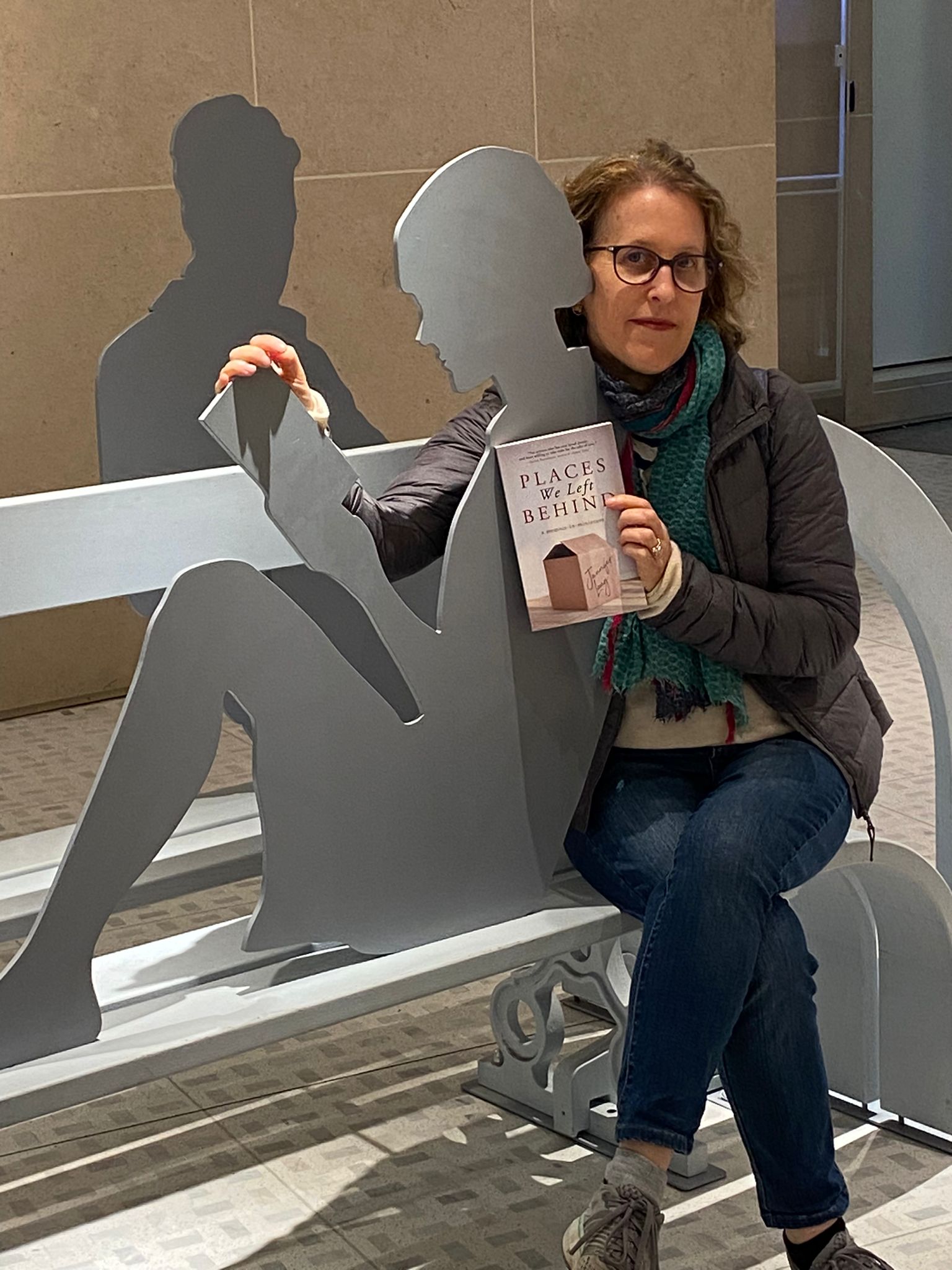 Born in the San Francisco Bay Area, Jennifer Lang lives in Tel Aviv. Flash in Midway Journal, Quarter After Eight, Ruminate, Atticus Review, and more. MFA from Vermont College of Fine Arts. Runs Israel Writers Studio. Her prize-winning Places We Left Behind: a memoir-in-miniature was released in 2023; Landed: A yogi’s memoir in pieces & poses will be published in October 2024.
 Emerge Literary Journal