by Sonia Greenfield
—Nova, PBS Online
My husband, the nurse,
is an anatomy lesson
in circulation. He flattens
a vein in his arm to show
where a valve prevents
backflow, his limbs a ropy
network of conduits.
As I trace blood that sits
proud of his musculature,
I consider how machines
fail. I remember that week
in the ICU when I tried
to die, the way staff
punctured my arteries
for oxygenated blood,
the purple bruises fading
like rainbows in reverse.
My husband then explains
how his patient was dead,
cells still firing, but heart
not pumping. He called it
pulseless electrical activity,
& we spoke of systems
in the language
of engineering, how
a failure of redundancies
sank the Titanic. We like
to forget the robot
is a robot until a spring
pokes out or a bug
is revealed in the code.
Because I want the mystical
& empirical, the double
redundant system, I tell
my husband, electricity resides
in the heart. That must be
God. Maybe he reached down
with a finger of broken light
to offer man fire. Maybe
on winter days He jumps
from hand to hand in static
crackles as I reach to touch
what I love. Can we say
it was grace that hooked
a boy’s soul when it tried
washing out to sea like a scrap
of shirt in a strong current,
away from the crux of tree
that caught him, away from
his tangled body cooling
in the rush of an icy stream?
Was it science in the service
of grace that gave doctors
the wherewithal to shock,
to warm him slowly, that gave
nurses the patience to pump
his chest for better than
an hour? A miracle, they say,
but what are we to make
of the way ions in impure
water conduct a charge?
A car crashed in a rainstorm
where downed power lines
electrified standing puddles.
Science says the woman
should not have run
to the car, should not have
jolted with the charge of forty
thousand volts. Where is
mercy in thermodynamics
when another woman
who touched the one stricken
also died, when two hearts
shocked are as likely to cease
beating as to beat precisely
because of shock? Children
released balloons in memory
of the women, who only
wanted to help. Archimedes’
principle says the balloons will
stop rising once their density
matches the surrounding air,
well before they ever reach
heaven. Here on Earth,
my mother was plugged in
like a cyborg, her skin flush
until the mechanisms were
hushed, & then her hue
went dusty gray. We grind
forward like the four wheels
on her gurney. The veins
in my husband’s calf
have fallen and zigzag
in haywire rivulets that look
like the cardiac rhythms
our bodies keep time with.
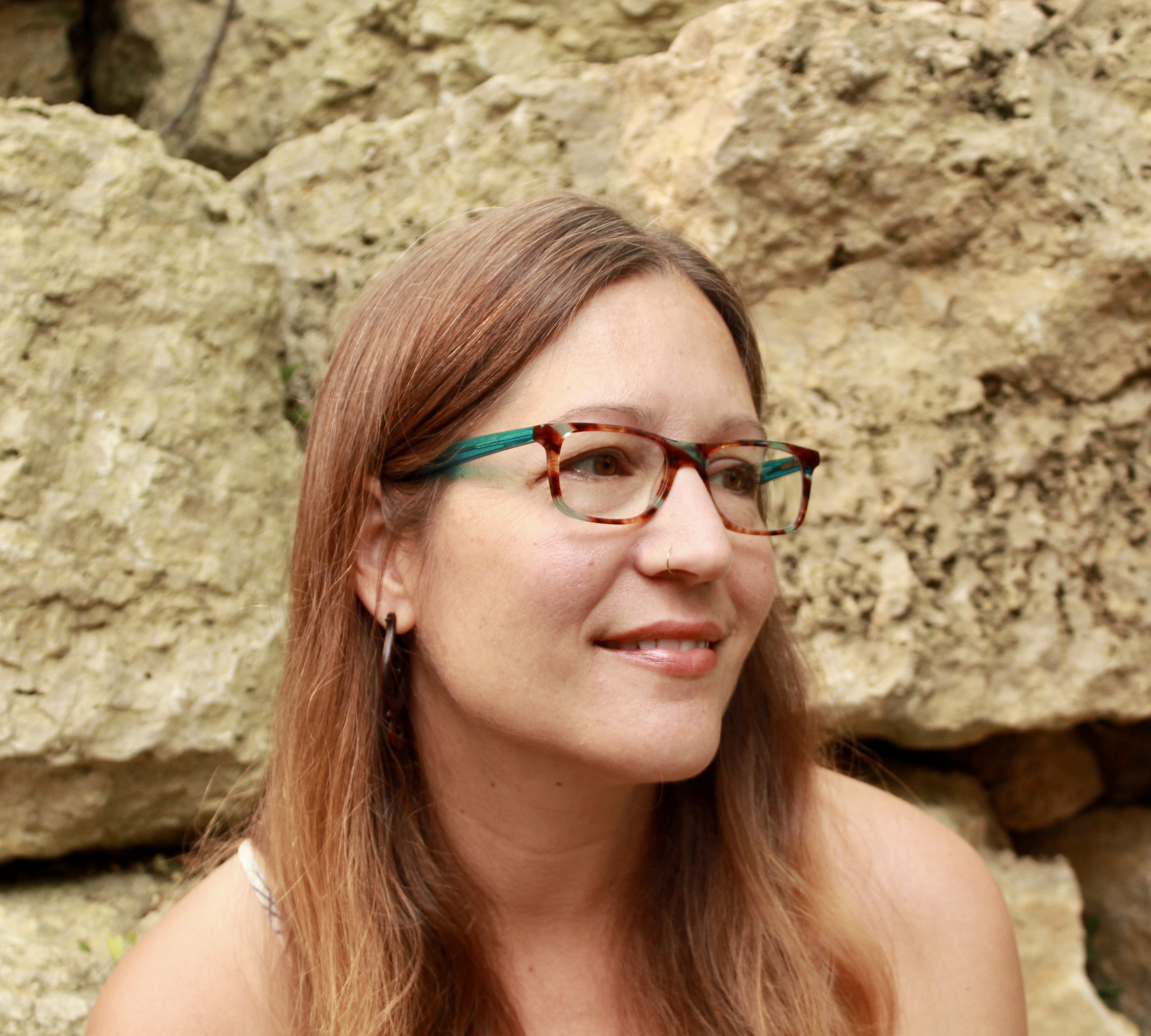 Sonia Greenfield (she/they) is the author of All Possible Histories (Riot in Your Throat); Helen of Troy is High AF (Harbor Editions); Letdown (White Pine Press), and Boy with a Halo at the Farmer’s Market (Codhill Press). Her work has appeared in the 2018 and 2010 Best American Poetry, Southern Review, diode and elsewhere. A 2024 McKnight Writer Fellow, Sonia lives with her family in Minneapolis where she teaches at Normandale College, edits the Rise Up Review, and advocates for neurodiversity and the decentering of the cis/het white hegemony.
 Emerge Literary Journal